
Begin with something easy to answer
Try a simple hello and a low-stakes question about an interest, a book or a piece of music. Leave a pause rather than filling every second. A stranger has no obligation to match your energy immediately or explain why they are quiet.
Avoid opening with a demand for a real name, exact location or personal contact account. Curiosity is easier to enjoy when it does not feel like an interview. You can offer a broad topic without expecting the same level of disclosure in return.
Check the context before changing the subject
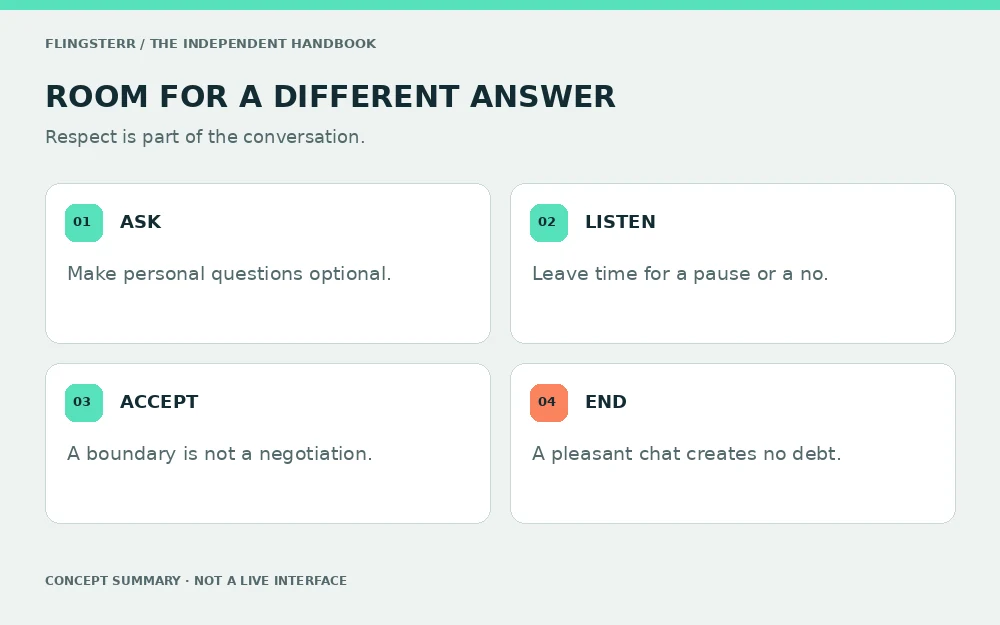
An adult-only environment does not tell you what a particular adult wants to discuss. Ask before moving into personal subjects, and make it easy to say no. A question is only optional if a different answer is accepted.
Do not treat earlier friendliness as permanent permission. People can change their minds, decide not to use video or end the conversation. Respecting that choice is part of the exchange, even when it interrupts the direction you had in mind.
| Instead of | Try | Why it helps |
|---|---|---|
| “Tell me your full name.” | “What would you like me to call you?” | Leaves identity disclosure optional. |
| “Come on, explain why not.” | “Okay, let’s change the subject.” | Accepts a boundary without bargaining. |
| “You owe me another chat.” | “Thanks; take care.” | Ends without creating a debt. |
| Recording a funny moment | Enjoying it without keeping a copy. | Respects the other person’s privacy. |
Accept a boundary the first time
A useful reply to “I would rather not” is “Okay”. Avoid asking for a reason, bargaining for a smaller version of the request or presenting disclosure as proof of trust. Those responses turn a choice into a negotiation.
Notice your own boundaries too. If a conversation starts to feel uncomfortable, say “I’m going to end the chat now” or simply leave. You do not need to persuade the other person that the boundary is valid before acting on it.
Protect the people outside the conversation
Keep other people’s faces, voices and personal details out of a call unless they agreed to be included. Do not pan the camera around a shared room as entertainment. A person nearby did not choose to meet everyone on the other side of your screen.
The same courtesy applies afterwards. Do not share a screenshot, recording or quotation that identifies someone without permission. A short encounter can still contain information that belongs to another person.
Leave room for different communication styles
Accents, pauses, a slower connection and unfamiliar phrasing can affect the rhythm of a call. Ask a neutral clarifying question if you are unsure what someone meant. Avoid making identity, appearance or language ability into a performance they have to defend.
A respectful conversation can also be brief. You do not have to turn a mismatch into an argument. If the topic or pace does not work for you, end it clearly rather than trying to force the exchange to improve.
End without a debt
“Thanks for the conversation. I’m heading off now” is enough. Do not insist on a new contact method or a promise to meet again. A pleasant exchange does not create an obligation to continue elsewhere.
If the issue is pressure or a threat rather than a simple mismatch, prioritise leaving and reporting over being polite. Our safety guide covers that distinction. Good etiquette never requires staying in a harmful interaction.
A respectful invitation includes a real opportunity to decline, pause or leave.
Questions & answers
What is a good opening line for video chat?
A simple greeting and a broad, low-pressure question are enough. Leave room for a pause or a short answer.
Does an adult-only setting imply consent to personal questions?
No. Context does not establish what an individual person wants to discuss or share.
What should I say when someone declines a request?
Accept it plainly and change the subject or end the interaction. Do not bargain for an exception.
Do I need permission to include someone in the room?
Ask before exposing another person’s face, voice or identifying details in your conversation.
Is it rude to leave a random chat?
You may leave. A short goodbye is useful when comfortable, but safety takes priority over politeness.
Does this guide provide scripted dating messages?
No. The examples illustrate respectful communication and do not promise a response or outcome.
Primary sources
Official pages reviewed 20 October 2026. Browser labels, service features and policies may change. Read the current source for details. This independent educational guide cannot verify another service’s internal systems or an individual user’s behaviour.